
On the morning of June 6th, 2026, I woke up before my 6:00 AM alarm went off. It was Day One of the Route 66 Centennial Caravan – so much planning and preparation had led to that day. I went to the lobby to get a cup of coffee and a quick bite, where I bumped into a few of my Caravan compatriots that were similarly wrestling with too much excitement to sleep any longer. This would become my pattern for the next three weeks, my tradition: wake early, eat a small breakfast, make last-minute preparations, and get our group out the door on time.
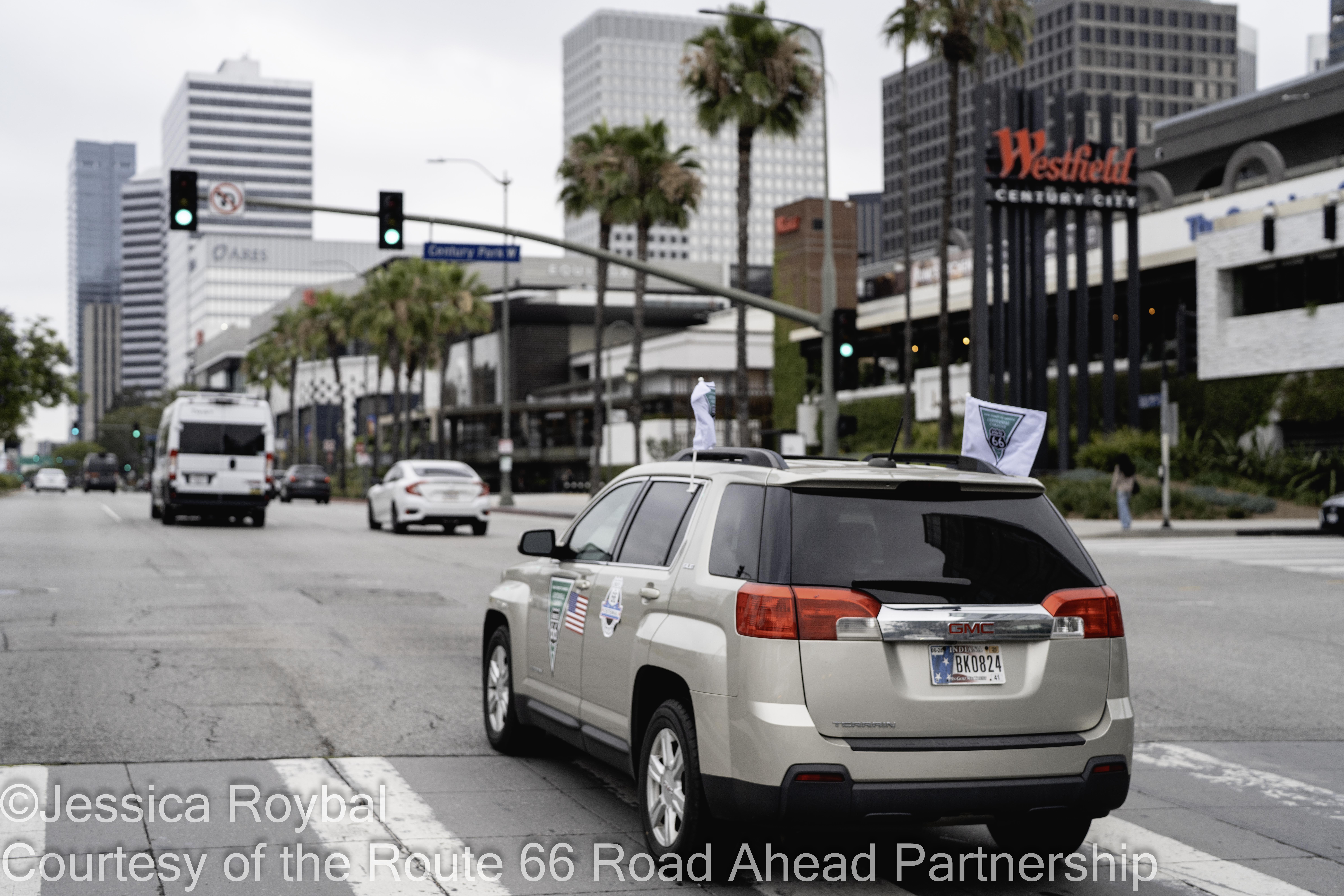
We drove less than 100 miles on that first day, starting in Santa Monica and ending in Pasadena – but it established many other traditions that would continue daily for the following three weeks. It also quickly revealed the gaps in what I had planned for and what would need adjustment over the course of our journey. We didn’t have a Driver’s Meeting before leaving that first morning. Turn-by-turn directions (provided for California by the most excellent Mike May of the California Historic Route 66 Association) would go from a “nice to have” to a necessity. There was confusion as to what the Core Leadership Team was responsible for and how the general caravaners would integrate into the planned itinerary. Much like the road itself over the previous century, the journey evolved as we headed east. We stuck to Historic Route 66 whenever possible, with only a few minor exceptions.
One of the changes that had to be made was our starting point. I had been alerted the previous day that the Santa Monica Pier and surrounding parking would not available for our group. Tere Stamoulis, also with the California Historic Route 66 Association & a DMO rockstar, saved our bacon on multiple occasions those first few days. She was able to secure parking at a lot a few blocks from the Pier. Disaster averted – and the first of many audibles we’d need to call along the way in the face of the unexpected.
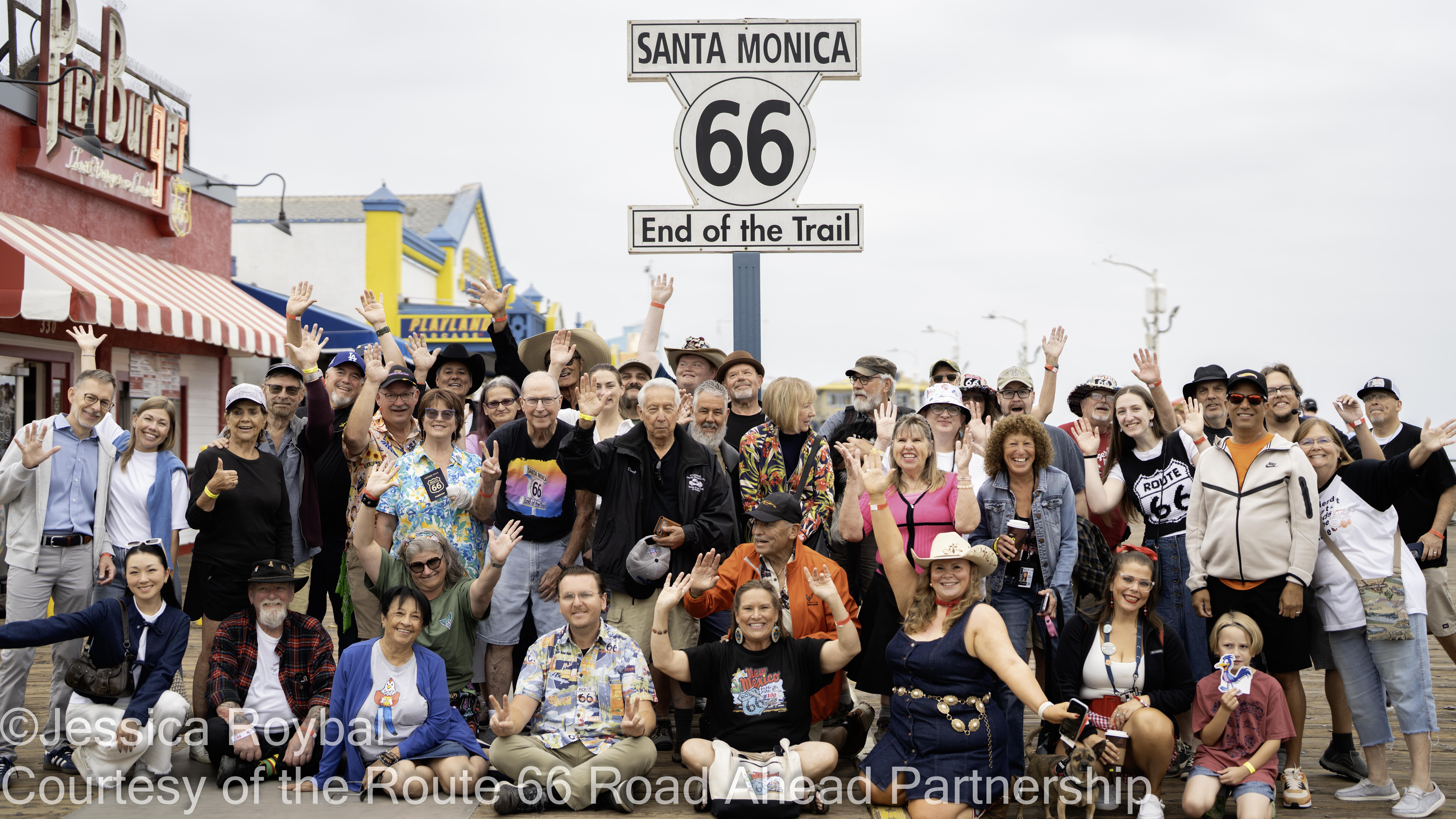
When we arrived at the Pier, my friend Ian Bowen greeted us. He manages the 66-to-Cali kiosk that sits a few feet away from the End of the Trail sign and was happy to see us on our way. I couldn’t believe it was actually happening! There we were, talking to reporters from the L.A. Times and taking photos as we began our long, symbolic journey. 45 of us crowded under the sign and stood nearby while Jessica Roybal, our official photographer, took a group picture…the first of many. The turnout was incredible, more than three times the Core Leadership count that we’d planned on. Everyone was so excited!
Route 66 never officially ended at the Santa Monica Pier. The rule was that a federal highway had to end at another federal highway – they couldn’t just stop at a dead end. The first official end of Highway 66 was in downtown Los Angeles. In the 1930s, this was extended to Santa Monica, specifically the corner of Olympic and Lincoln. Mel’s Drive-In sits there today – and although there wasn’t enough room (or time) for our group to stop, we drove past and waved to ensure we paid tribute to both the spiritual end of Route 66 as well as the literal end.
One of the reasons that we’d decided to start in the west and head towards Chicago was so that California didn’t feel like a race-to-the-ocean after crossing the border. Southern California gets a bad rap for the traffic and the dense population, but each community has a unique story to tell and many of them take immense pride in being a part of the greater Route 66 corridor. We had several shining examples of this on Day One, starting with Beverly Hills.
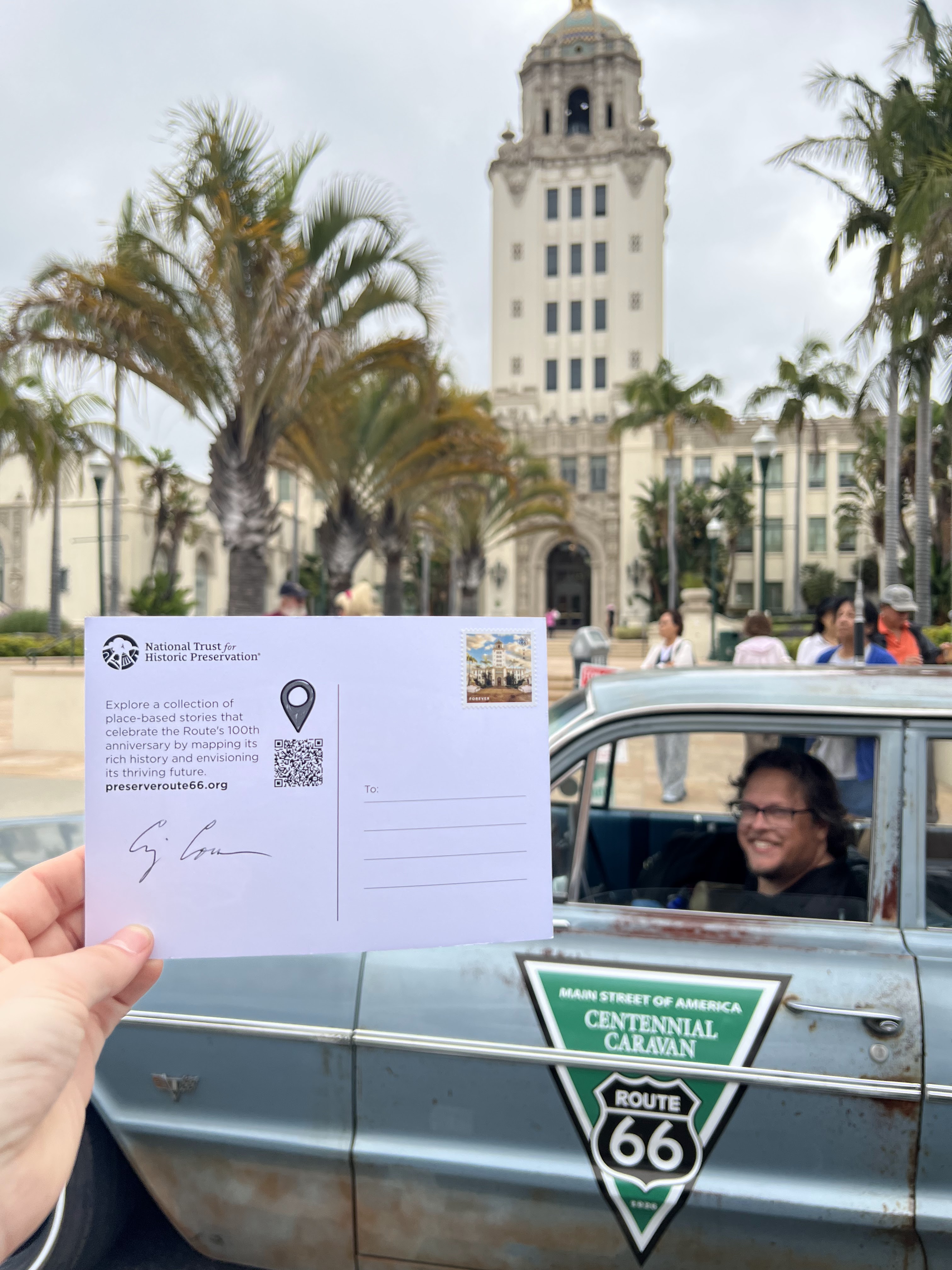
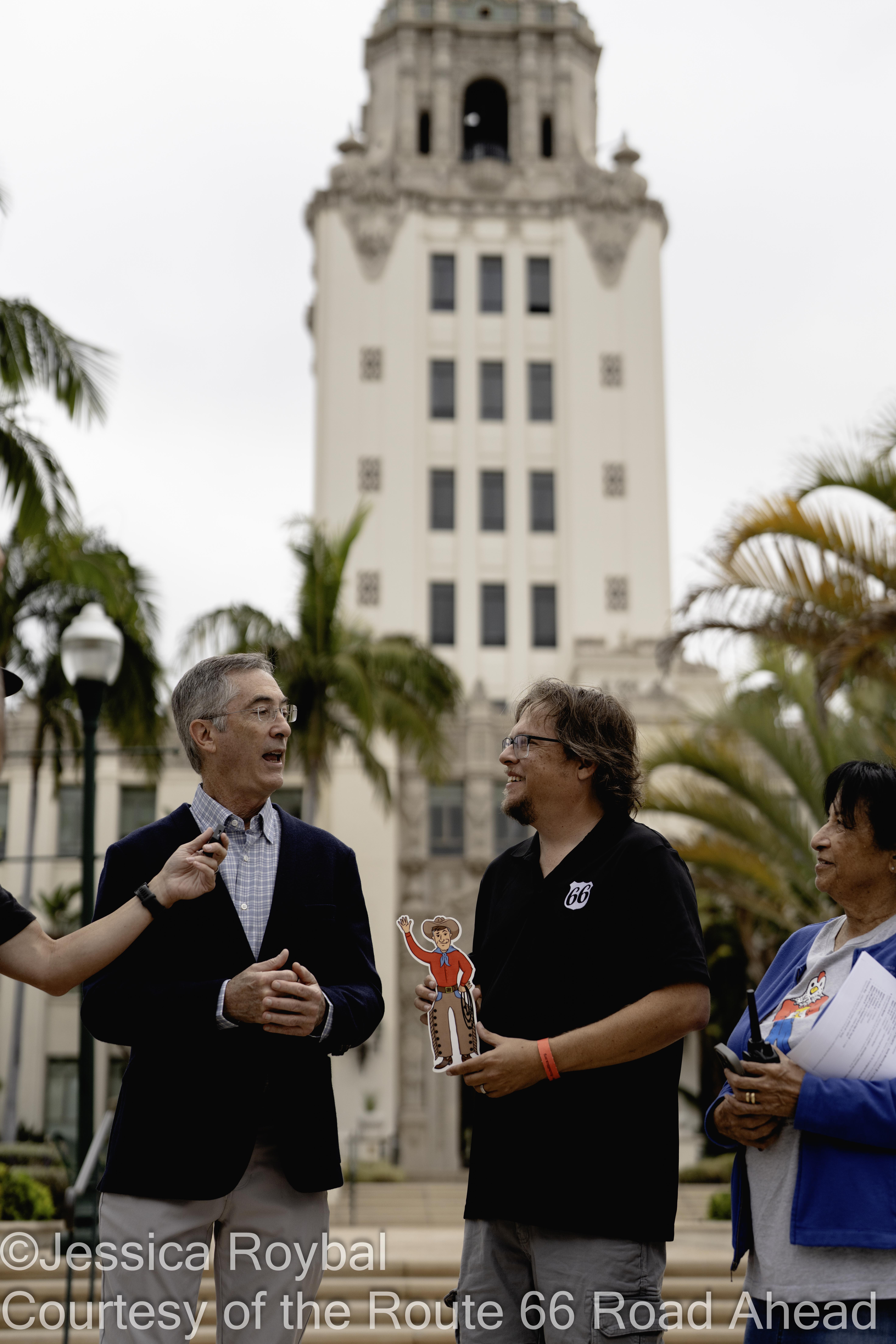
The mayor and several city council members were there to greet us; they even closed off a few lanes of traffic for our group to park right in front of City Hall. The iconic tower had just been featured in a postal stamp series celebrating the road’s Centennial, representing the entire state of California. Back in the 20s, Will Rogers had even been made honorary mayor of the town. In true Okie fashion, I made sure they knew that Route 66 was also known as the Will Rogers Highway and gave them a Flat Will to celebrate that connection.
We had a police escort to get us from Beverly Hills to West Hollywood, where another escort would guide us through a closed section of Santa Monica Boulevard (Route 66). Why was it closed, you ask? It was the first day of West Hollywood Pride! When their city leaders and festival organizers heard about our Caravan coming through, they made space for our Core Group to continue on the road, using the emergency lane through the festival as the vendors were setting up. It was a remarkable display of community pride, celebration of identity, and how Route 66 is so much more than many people give it credit for. No matter who you are, where you’re from, or what you believe in … you can find your reflection somewhere on that old highway. We honked our horns as we were welcomed by waving spectators and festival-goers. It was really special.
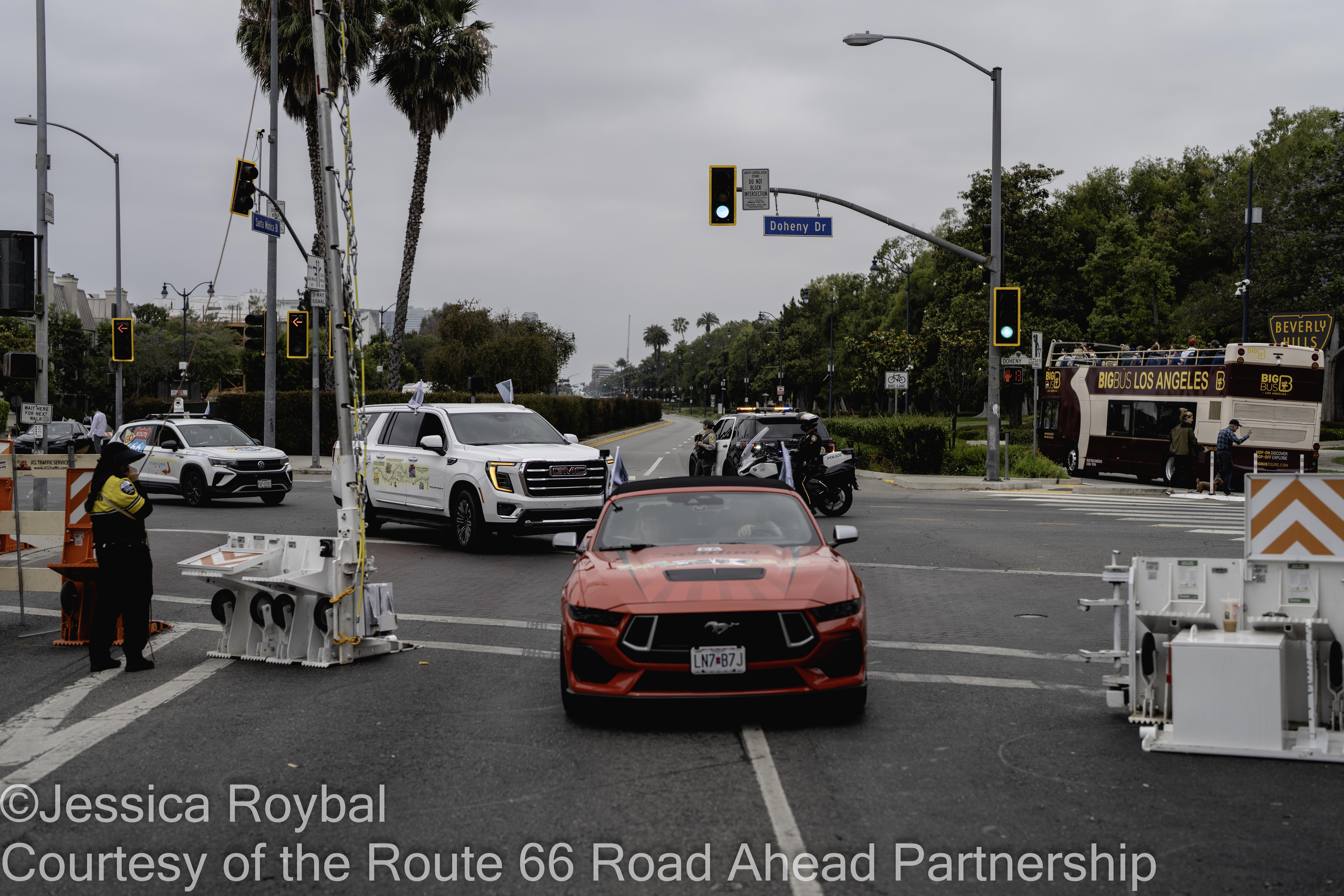
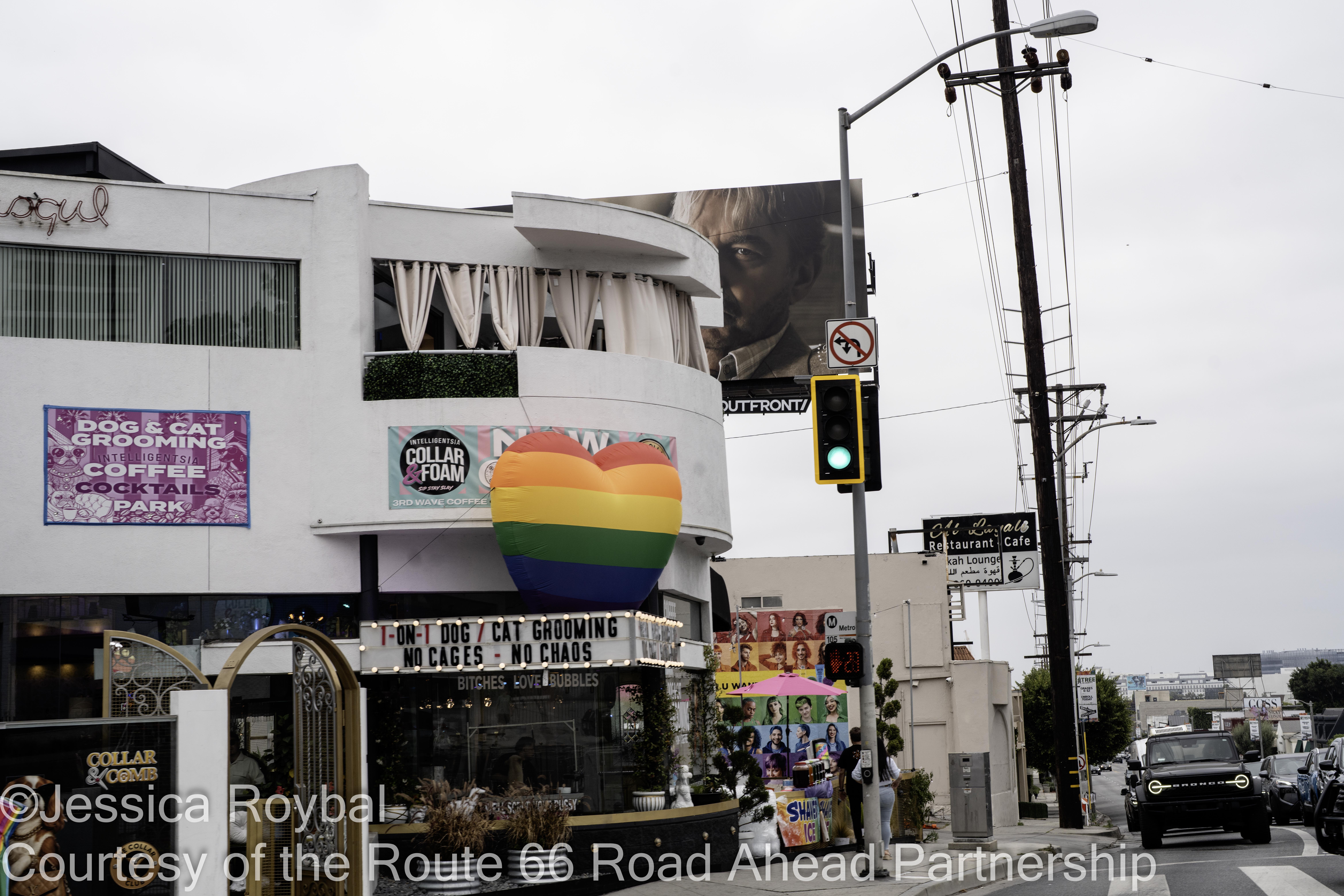
The rest of that morning was spent squawking on the radios, giving location updates, lane-change notifications, and trying to keep the group as tight as possible. Since the general caravaners weren’t able to proceed through West Hollywood due to our size, we all met up downtown for lunch at Grand Central Market.
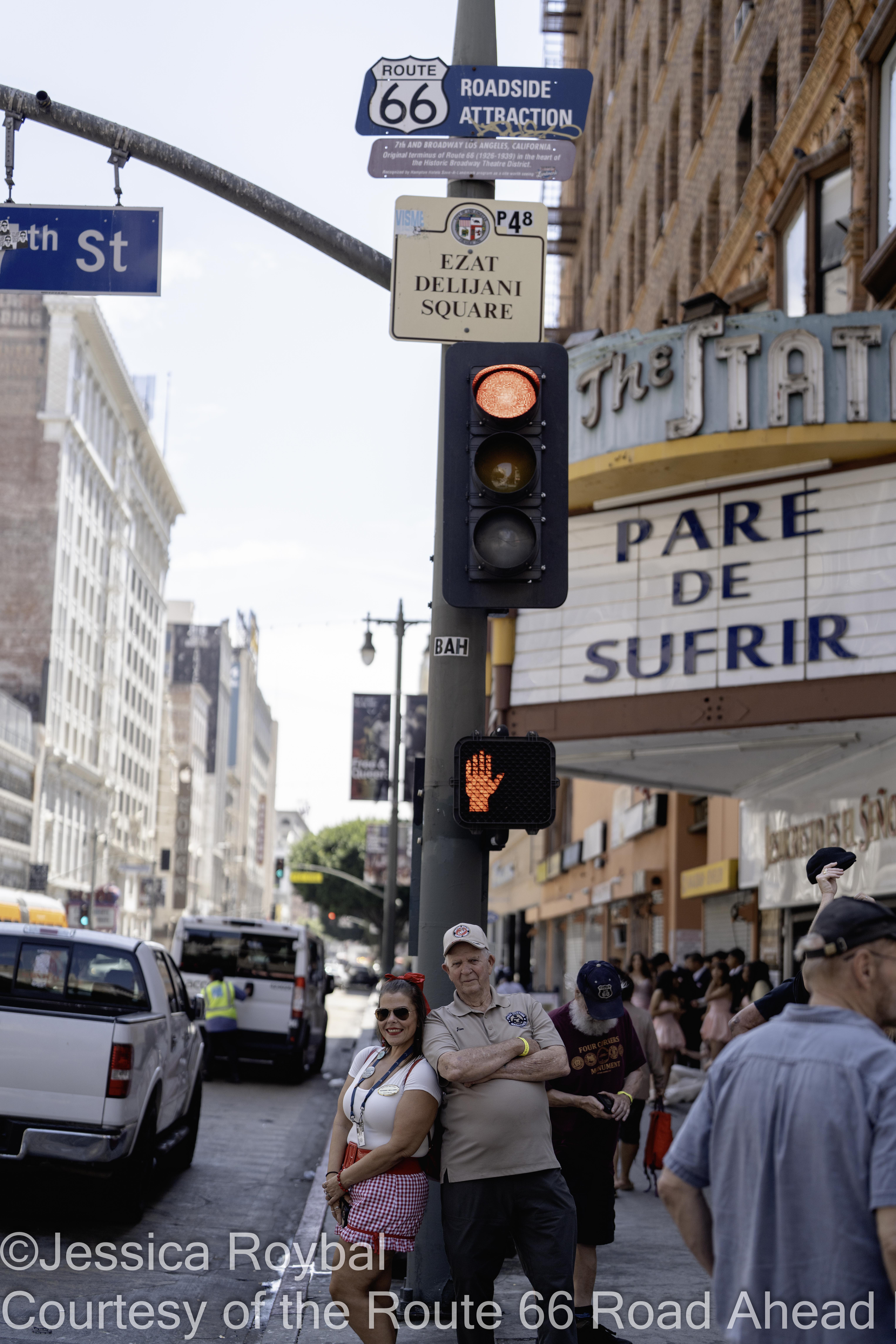
Once everyone got some food in ’em, Beth Murray and others from the California Historic Route 66 Association led a walking tour of Broadway and the Historic Theater District. The hour-and-a-half educational experience was wonderful, but I couldn’t quite relax. Logistics with a traveling group like this never stop. When did we need to head back to our cars to ensure we stayed on schedule? Is everyone accounted for? Have any new messages come into the WhatsApp channel? Does anyone need water? My head was on a constant swivel, checking in with people and keeping our group together as much as possible.
When the tour wrapped up and we all returned to our cars, most of the group headed out of downtown towards Chicken Boy, a delightfully quirky and custom Muffler Man statue that had also traveled from Broadway downtown. It was preserved and restored after its original restaurant closed and has become an icon in its own right. Much of our traveling troupe stopped and learned more about the statue and its history, but I was not one of them. Parking for a 1964 Chevrolet station wagon in a big, busy city can be dicey and I couldn’t find a spot I was comfortable with; instead, I radioed the core team that I would be proceeding to our next stop to scout parking and provide guidance.
Parking at Galco’s Soda Pop Stop was much easier – and my early arrival meant I finally had a moment (just a moment) to relax. Several of our caravaners had made the same decision – one of them was William Cooke, who I’d met in April and had the pleasure of riding in his coral-colored Edsel through Oatman, Arizona. William had taken the initiative to reserve a number of parking spots for us and even had a few camping chairs set out under a shaded area. William’s father and his friend Danny were there, too.
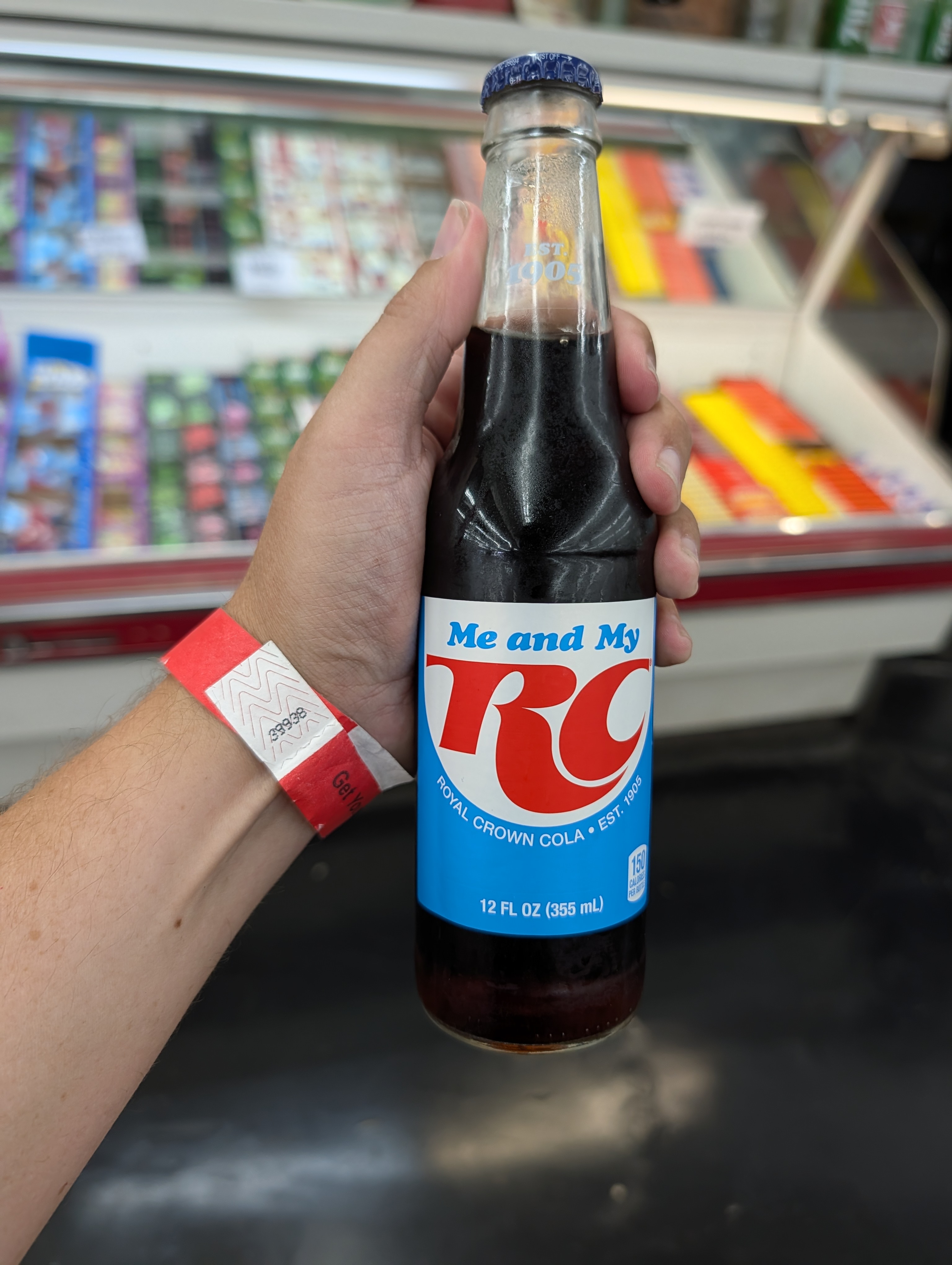
I’d never heard of Galco’s before organizing this trip and what I discovered made my heart happy. Galco’s was originally a grocery store that dated back to 1897. It moved to Highland Park in 1955 and transitioned from a full grocer to an independent soda-and-snack store in the 90s. They have hundreds of rare and hard-to-find sodas on the shelves, vintage candies, and even a sandwich counter. I was told that the folks that built Pops in Arcadia, Oklahoma were inspired by Galco’s when they created their big travel stop in 2007. With my few minutes of freedom, I grabbed an RC Cola, a Hershey Bar, and joined the Cook Crew in the shade. Danny was also driving an Edsel, a beautiful and pretty rare 1960 edition. That group, among quite a few other people, would remain with us for the rest of the journey…all the way to Chicago.
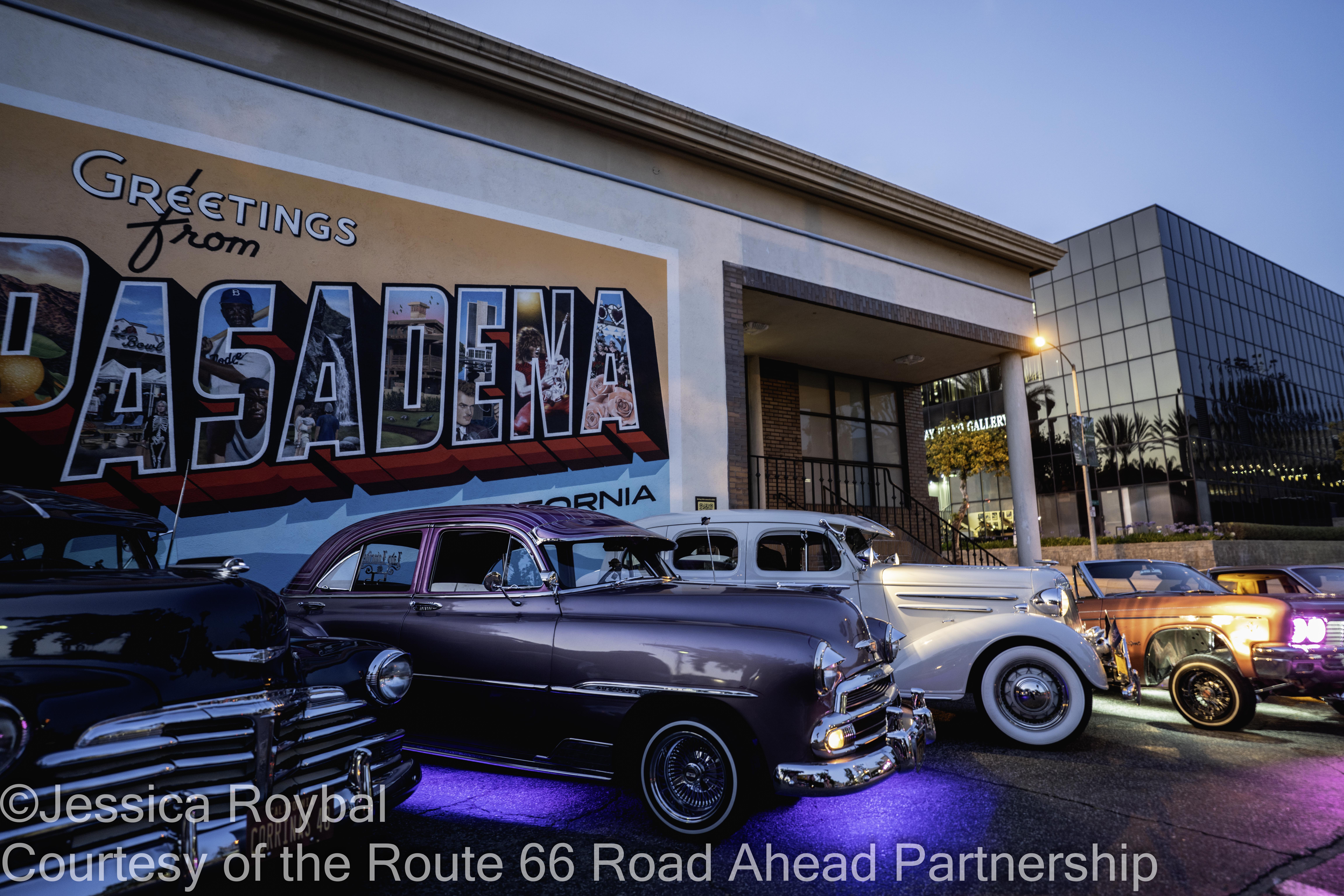
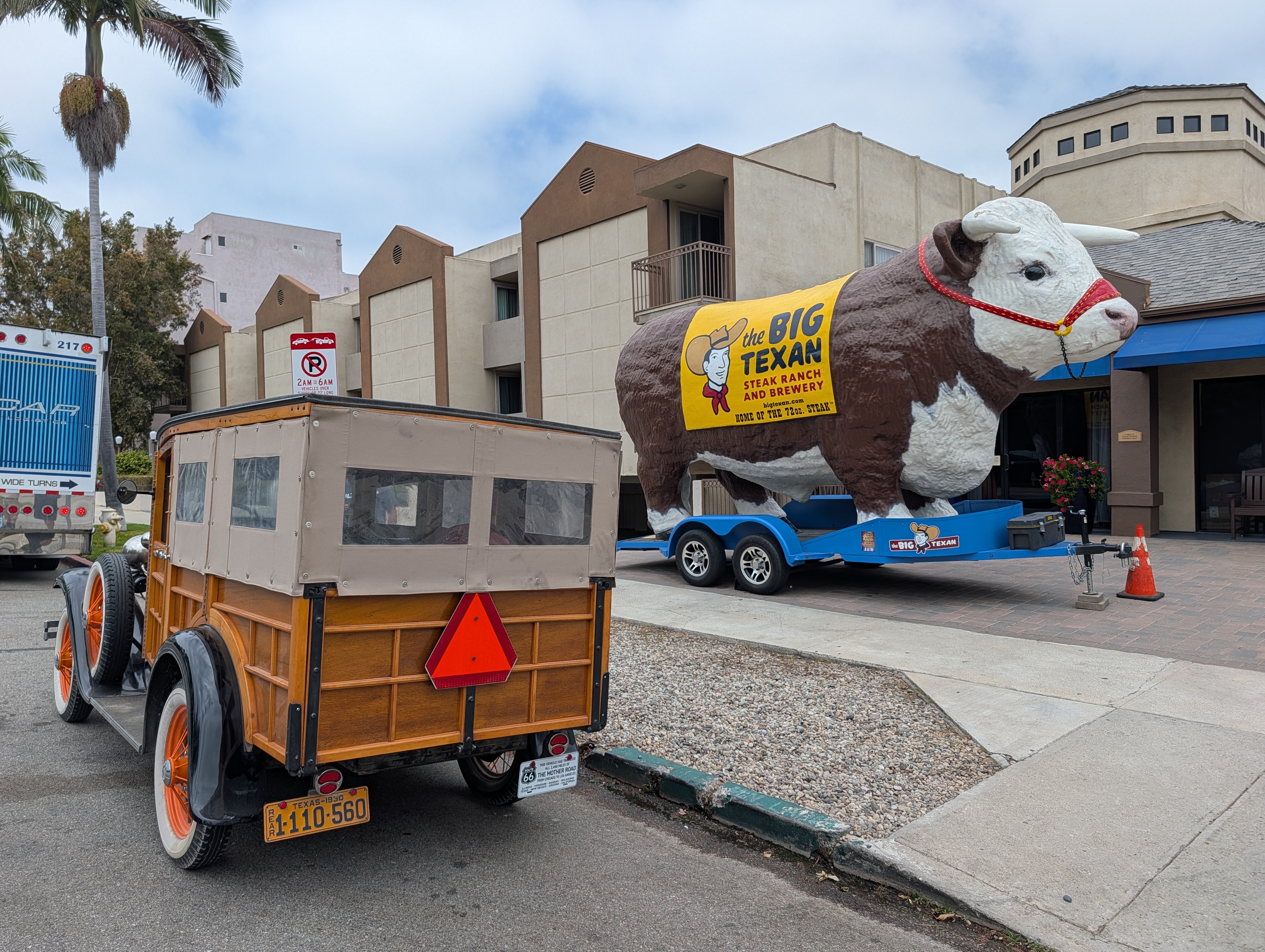
The rest of the Caravan arrived in short order, where folks had an experience similar to mine. Fueled up for the last leg of our day, we left Highland Park and headed for Pasadena…and the Big Texan Steak Challenge. We assembled in another parking lot, this one featuring a beautiful new mural that emulated a vintage postcard. Big Moo, the giant fiberglass cow, welcomed us as the wafting smell of grilled meat filled the air. Dozens of locals had assembled to watch several competitors give the 72 oz. steak challenge their best shot. During the challenge, the Big Texan folks asked me to step up on stage to explain the Caravan and what we were all doing for the next few weeks. This, also, would become a tradition. It was a remarkable gathering, made all the more special when the USC Trojan Marching Band showed up to play some music for us. I couldn’t believe it.
It was 9:00 PM by the time most of us made it to the Best Western in Pasadena. I checked into my room and called Samantha to tell her about the day’s activities, even though it was quite late back in Oklahoma. She was waiting on my call. I gave her the quick version of the day and agreed with her when she said it sounded incredible. She asked how I was feeling and I paused. I thought about it longer than I expected.
“I don’t know if I can do this,” I admitted.
I was utterly exhausted. When we announced the Caravan, we’d invited people to just show up and join us for a cruise. It had become clear very quickly that there were expectations of a formal Route 66 tour, the kind that people pay thousands of dollars to be a part of. Keeping our group together and ensuring our fellow travelers were satisfied was going to be a lot more work than I had expected. We’d already put a ton of work into designing the itinerary and had connected people through several communication methods…but it wasn’t enough. I didn’t know if we would be able to meet those expectations. Samantha, like always, was able to calm me down and level my thinking. She helped me find the courage and energy to find a path from where I was at and where I needed to be.
I went to bed that first night totally spent – but determined to do everything I could to make the next three weeks an unforgettable experience for everyone.


Rhys! The Caravan was the experience of a lifetime; and while I know it took a village, your leadership and indefatigable presence and support were the gift of a lifetime…I think particularly to those of us who were not part of the core group and joined the Caravan for what parts we were able. Now, as you write about and allow us to relive the experience, you’ve doubled that gift. Reliving the trip through your words, thoughts, and emotions is the sweetest trip down memory lane–both of the distant past and the recent past we got to experience because of you and the many folks who worked tirelessly to make the Caravan a huge success. We thank you from the bottom of our hearts.
My thoughts after being on the road, 20+ days with the Centennial Caravan and Rhys Martin as lead guide. It was a life changing experience. Thank you so much Rhys.
Many of us, if not all of us, live in echo chambers of our own making. We only hear our own thoughts, ideas, and philosophies. It gets to where the reverberations and the echoes block any other thoughts or ideas, leaving no room for debate or compromise. The mass media, no matter what you watch or read, only reinforces the walls of our chambers. But I know our great country is better than that, so with my wonderful wife Shelley’s encouragement, we followed the Simon and Garfunkel song – “they’ve all come to look for America” – and went on a cross-country adventure.
We left the safe confines of our Ocean Pines home and proceeded past the lush farms and valleys of the Allegheny and Appalachian Mountains. We then crossed the heartland of this country where farms are measured in hundreds of thousands of acres and the interstate highways are mere ribbons of asphalt and concrete through vast fields of corn and wheat. We then went through and over the majestic Rocky Mountains, where Shelley noted that only G-D can make trees grow in those rocks; and yes, there are tens and tens of thousands of trees growing in those rocks. Then across the Mohave Desert and we finally reached the Golden State – California. We dipped our toes in the cool Pacific waters and prepared for our real journey. We were joining a caravan of twenty some cars, going through eight states, and traveling the entire length of Route 66 from Santa Monica, CA to Chicago, IL, covering 2448 miles. We were going to celebrate the 100th Anniversary of the commissioning of US Route 66. Along the way we hoped to meet some nice people, learn some history, and also see parts of our great country that we normally don’t see. Our main guide, Rhys Martin, was knowledgeable, interesting, and keenly interested in keeping everyone highly involved.
After leaving the Los Angeles area, where keeping the caravan together was difficult at best, we settled down and started to learn about and enjoy Route 66. As we travelled some folks left the caravan and others joined the group, little by little our numbers were growing. Every day brought a new appreciation for the Mother Road and the wonderful people that live all along the long road. We discovered after several days on the journey; an amazing transformation was occurring. We started out with the caravan to celebrate 100 years of blood, sweat, and tears – yes, many tears – of Americans making the Mother Road the magnificent roadway of America to the promised land of golden opportunities, California. Each passing day we saw more and more people proud to be Americans, waving American flags, and cheering us on in our venture. The friendship and hospitality were never ending and immense. In town after town people came out to meet us, greet us, feed us, hug us, and then send us on our way with police escorts. The high point for us was Oklahoma City, not a small town to be sure with a population of over 175,000. As we were led by a tremendous police escort, our caravan now numbering close to 100 hundred vehicles, was cheered on by thousands and thousands of bystanders. There were school children, people coming out of their homes, people coming out of shops, half the cast of “Street Outlaws” (IYKYK) were there yelling and screaming encouragement and everyone waving at least one American flag. The celebrators had become the celebrities. Once again radio and TV came out to interview and film us for the evening news. More than any other place, I felt people’s love of America, people’s patriotism, and their genuine friendship like nowhere else. As we got closer to Chicago, some folks left the caravan citing work or family obligations. The reduction in numbers did not however reduce our love of the journey. Even in Chicago people received us with love and joy, grateful that we were almost at the end of our grand journey. However, that last leg, from the Castle Car Wash to the Navy Pier, with all of the construction and typical Chicago city traffic proved too much to overcome as the caravan broke up into many individual pieces of a long caravan, many of us just driving up to Navy Pier and then calling it over, and starting the journey home.
After we got home and had a chance to start to decompress, we evaluated our experiences of the past month. We were totally exhausted from waking each day at 6 or 6:30 and being on the go until 6 or 7 at night. Each night in a new hotel. Learning how to properly drive in a caravan, not too close and not too far, so the caravan becomes a uniform line of vehicles going down the road. We found the America that doesn’t exist in the Coastal cities nor in the mass media. We felt grief and tragic loss for the one accident that should not have happened. But we also felt great joy meeting so many wonderful people that gave time, effort, and funds to make sure we were safe, sound, and happy before allowing us to continue our journey. All of this can be condensed in one stop along our way in Tucumcari, NM. Tucumcari was once a huge transportation center. Since the advent of the Interstate Highway System, Tucumcari has become just short of a ghost town, only recently seeing a revival and folks trying to get their hometown on its feet again. While we were checking out the Blue Swallow Motel, I saw an Orthodox Jewish man standing there. I knew he was an Orthodox Jew because he was wearing a Kippah (head covering) and “tzitzits” (religious frock with fringes at the four corners). We struck up a conversation and he told me that his family was the only Jewish family in Tucumcari, that they moved from Denver over eight years ago, and they would never leave because they found peace, serenity, and brotherhood like nowhere else. That is the message we came away with all along Route 66, everywhere there was peace, serenity, and brotherhood.
We went to look for America and we found that America is alive, well, thriving, hospitable like nowhere else, and building a new and better tomorrow. My Tucumcari Jewish brother said it so concisely, we found peace, serenity, and brotherhood from white, black, brown, yellow, red, and everyone in between. Although tiring, it was a truly joyous trip, one we are so glad we took, one we will never forget.